
Tennessee Correction Release Scope
The Tennessee Department of Correction manages state prisons and supervises people on state parole and probation. No active TDOC prison was verified within Hamilton County. The agency belongs on the facility map because Hamilton County defendants who receive felony state sentences may enter TDOC custody, and residents released from state institutions may be assigned to supervision in Chattanooga. A TDOC record should never be described as a booking at a local Hamilton jail.
TDOC does not cover every person who leaves the county jail. A defendant who bonds out on a local charge, completes a county misdemeanor sentence, or has a case dismissed may never enter the statewide felony system. Conversely, a person who disappears from the HCSO roster and then appears as incarcerated in TDOC has most likely changed custodians. That movement is not a community release. The TDOC record becomes the current source, while HCSO documents departure from the county facility.
TDOC FOIL Release Search
Felony Offender Information Lookup, known as FOIL, covers felony offenders currently or formerly in TDOC custody or under TDOC supervision. Search by name and narrow the match with date of birth or a TDOC/TOMIS number when available. Open the detail and compare the photograph, middle name, birth information, offense, county, sentence, and assigned location. Save the TDOC number because it is the strongest key for later contact or archived-record requests.
FOIL may show a photograph, location, offense, sentence information, release information, parole-hearing information, and statuses such as incarcerated, parole, probation, or inactive. “Incarcerated” means the person remains in state custody. “Parole” means conditional community release before sentence expiration. “Probation” identifies community supervision. “Inactive” means the public display does not show active TDOC incarceration or supervision, but the release and sentence fields must still be read before a discharge is claimed.
| FOIL field | How to read it |
|---|---|
| Status | Current displayed relationship to TDOC |
| Assigned location | Institution or supervision assignment shown |
| Release information | State release details when present |
| Release Eligibility Date | Earliest eligibility point, not a promised exit |
| Parole hearing status | Hearing information, not proof of release |
| TDOC number | Stable identifier for the state record |
The project’s successful capture comes from the official TDOC FOIL page.
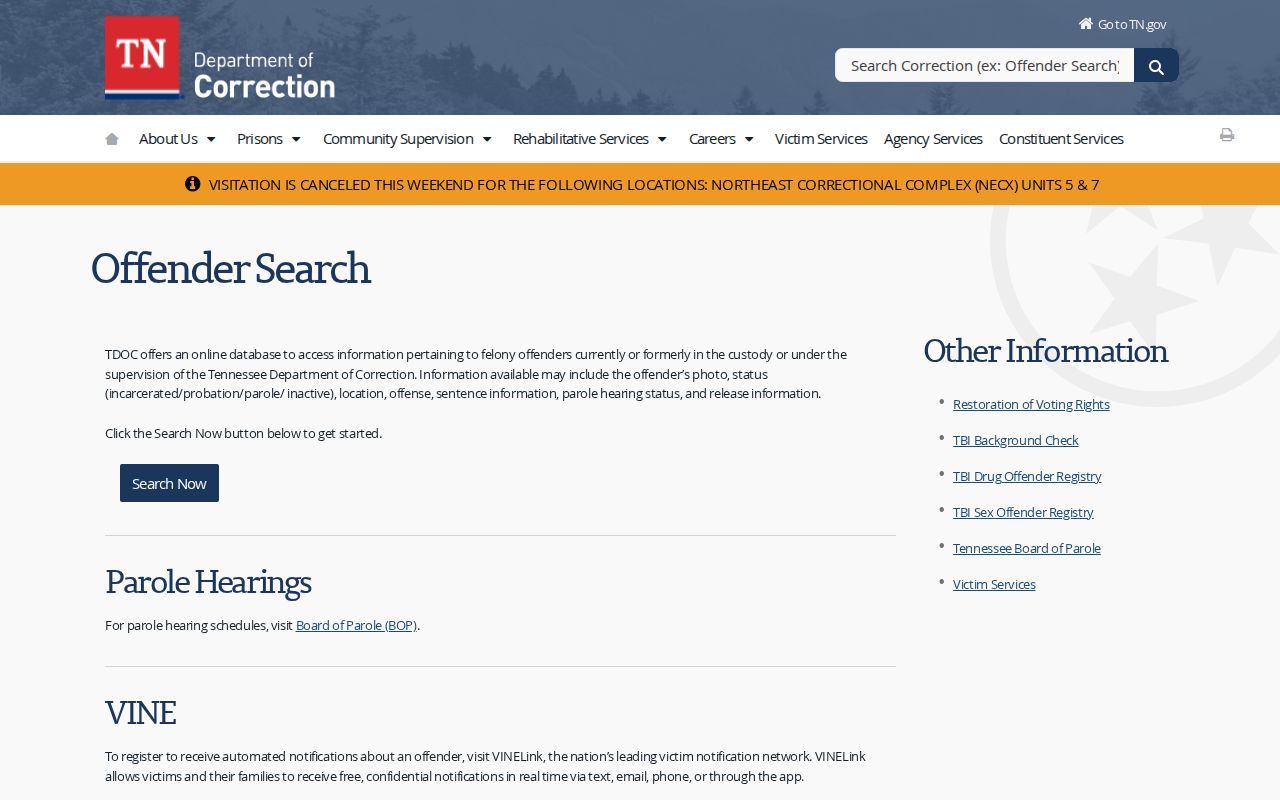
It identifies the correct statewide lookup while the field checks above prevent an eligibility date from being mistaken for an actual release.
Confirm TDOC Releases
A state release should be confirmed with more than one line on a search result. Begin with FOIL, then read the exact status and every date label. If the result shows parole, pair it with the final Board action and TDOC release documentation. If it shows inactive, inspect release information, sentence end data, active-sentence blocks, and archived records before describing a completed discharge. A discharge means the relevant custody or supervision obligation has ended; it is not the same as parole.
VINE supplies event-driven alerts for TDOC as well as Tennessee county jails. A release alert shows that the reporting custodian changed its record, but it does not rule out a detainer or same-day handoff. A detainer is a legal request or basis for another agency to take custody. Save the alert’s exact event, agency, date, and time. Follow the receiving system when the wording indicates transfer.
- Search FOIL by name and a second identifier, or use the TDOC number.
- Compare the person, offense, county, sentence, and location before accepting the match.
- Read Status, release information, sentence information, hearing information, and the exact date labels.
- Check VINE for the reporting agency’s event and timestamp.
- Ask TDOC for the release authorization or archived record when documentary proof is needed.
- Follow any detainer or receiving agency before calling the event a community release.
Note: FOIL’s former-offender coverage makes it useful after release, but a county-only Hamilton booking may never appear there.
TDOC Release Eligibility Date
The exact forward-looking field is Release Eligibility Date, often shortened to RED. It is the earliest point when an eligible person may be considered for parole or another statutory mechanism. It is not a projected gate date, sentence expiration date, final Board vote, or promise that release will happen. Reaching RED creates eligibility for consideration. The Board may grant, deny, defer, continue, rescind, or otherwise act on the case under the rules that apply.
Tennessee does not have one simple percentage for every sentence. TCA § 40-35-501 uses offender ranges, offense categories, offense dates, and special rules. The research identifies examples of 30 percent for Range I, 35 percent for Range II, 45 percent for Range III, and 60 percent for career offenders, subject to the controlling subsection. Some offenses have 85 percent or 100 percent frameworks. Consecutive sentences, mandatory minimums, court credits, and later changes can alter the calculation.
Sentence-reduction credits under TCA § 41-21-236 may be earned, withheld, forfeited, or restored under law and TDOC policy. Corrected judgments, added consecutive cases, delayed jail-credit records, discipline, appellate action, Board action, detainers, and statutory amendments tied to an offense date can change a displayed calculation. The controlling judgment and TDOC sentence-management record outweigh an informal estimate.
| Date or action | What it proves |
|---|---|
| Release Eligibility Date | Earliest statutory eligibility point |
| Parole grant | Board approval, subject to processing and conditions |
| Release authorization | Administrative authority and release details |
| Sentence expiration | Calculated end of the state sentence |
| Actual custody status change | Operational departure from the reporting custodian |
TDOC Release Authorization Records
TDOC policy 511.03 describes a formal release-authorization record. Its fields include release type, release date, sentence expiration date, releasing authority, detainer information, and intended residence city and state. That record is stronger than a calculated eligibility field. It also preserves the difference between a community release and a handoff to another custodian. Protected data may be redacted.
For older material, use the TDOC Archived Record Request. Supply the full name, TDOC or TOMIS number, date of birth, and other needed identifiers. Ask specifically for the release authorization, discharge record, or sentence computation rather than an entire institutional file when those are the needed items. A focused request can reduce ambiguity and limit disclosure of unrelated personal data.
If a release record conflicts with a court judgment or online result, document both dates and ask TDOC to explain the chronology. A court order may authorize movement before institutional processing is complete. A public record may also update after corrected documents arrive. Do not silently choose the date that seems most convenient.
Hamilton TDOC Release Supervision
The Tennessee Board of Parole makes parole decisions for eligible state offenders. TDOC supervises parole and probation in the community. A Board grant is not proof that the person left prison on the hearing date. Release may wait for a certificate, plan approval, detainer resolution, or another condition. Confirm the final action, then read FOIL status and obtain the release authorization when the distinction matters.
Hamilton County is assigned to TDOC District 30. Contact the local office after FOIL indicates community supervision and a direct verification is needed. An absconder is a person alleged to have stopped complying with required supervision contact. That term does not merely mean that family or friends do not know the person’s address. A violation or warrant can lead to arrest, while only the proper authority can decide revocation or discharge.
TDOC District 303602 Elwood Lane
Chattanooga, TN 37416
Phone: 423-634-6333
Fax: 423-634-6364
Confirm assignment and hours before appearing.
For proof that supervision ended, request a discharge or termination record using the TDOC number. An inactive FOIL status is a useful clue, not a substitute for the official document. Court completion entries can corroborate probation, while a Board final action controls parole decisions.
Hamilton Transfers Into TDOC Custody
A common Hamilton sequence begins with a county booking and ends with a state commitment. HCSO may stop displaying the person after transfer, while FOIL begins showing an incarcerated status and a state location. That pattern supports a change in custodian, not freedom. Match the HCSO SPN and identity to the TDOC number, offense, sentence beginning information, county, and assigned institution.
If FOIL shows incarcerated, the person remains in state custody. If it later shows parole, the person has left prison for conditional supervision, subject to confirmation of the displayed event. If it shows inactive, read deeper before assigning a release type. A “no active Tennessee sentences” message does not rule out a local, federal, immigration, or another state matter.
The Hamilton County released-inmate search path can help identify the county booking and court case before the TDOC stage. Keep the events separate in any written timeline: HCSO departure, TDOC admission, Board action, state release, supervision, and discharge may all occur on different dates.