
Hamilton County Three-Day Release Records
No verified official HCSO rolling 72-hour release view exists. The sheriff provides a current Inmate Information search, a Full List of current inmates, and a Booking Reports calendar. The calendar accepts one date at a time and reports admissions. It does not report departures. Selecting three dates only produces three sets of bookings, not the people who left the jail during those days.
A real three-day window would include someone booked before the window but released during it. It would exclude someone booked during the window who remained in custody. That difference becomes more important after a weekend, when booking dates and release dates may fall on opposite sides of the chosen range. HCSO has not published a release-feed cadence, online retention period, or weekend posting rule that would support stronger assumptions.
Check Hamilton County 72-Hour Releases
Set the exact range first. Write down the beginning and end times rather than relying on “three days ago.” Then work from a known name, age or date of birth, booking date, arresting agency, and SPN when available. This approach is slower than opening a feed, but it keeps bookings, court events, releases, and transfers from being mixed together.
- Search the HCSO current inmate tool by last name or SPN. Save the time and whether the person appears.
- Review the relevant booking dates for admission context. Do not count a booking as a release.
- Search Tennessee VINELink for the named person and match the agency, identifier, and available identity details. Preserve any event wording and timestamp.
- Call the Hamilton County Jail & Detention Center at 423-209-7125. Ask for the exact departure time, release type or authority, and any receiving agency.
- Use Hamilton CJUS or the clerk to confirm the bond order, dismissal, sentence, time-served judgment, or transfer authority behind the event.
- Request the HCSO booking and release record when a written three-day chronology is required.
For a period confined to today, the Hamilton County 24-Hour Release List page gives the narrower workflow. The larger window should not change the evidence standard. It only changes which events and dates must be reviewed.
Note: Save the range and lookup time with every result so a later roster change does not blur the original check.
Hamilton County Release Fields Compared
The public booking report can establish that HCSO recorded an arrest or booking on a selected date. It displays the person’s name, reported address components, age at arrest, arresting agency, charges, and related booking context. It does not show the release evidence needed for a rolling three-day list.
| Needed release field | Public booking report status | Best source |
|---|---|---|
| Name and booking identity | Name appears; SPN may require the matched record | HCSO booking or release record |
| Release date and time | Not displayed | HCSO release event or timestamped VINE alert |
| Release reason or type | Not displayed | HCSO record plus court order |
| Bond disposition | Not displayed | Clerk or CJUS, then HCSO departure confirmation |
| Destination or receiving agency | Not displayed | HCSO transfer record and receiving system |
| Booking photograph | Not visibly displayed | Matched HCSO result or records request, subject to access rules |
Release language also needs care. Bond is pretrial release, not a completed sentence. Time served can resolve the custody term in one case while another hold remains. A transfer to TDOC, another jail, federal custody, medical custody, or ICE means the person left HCSO but did not necessarily enter the community.
The official HCSO Full List demonstrates the current-custody scope.
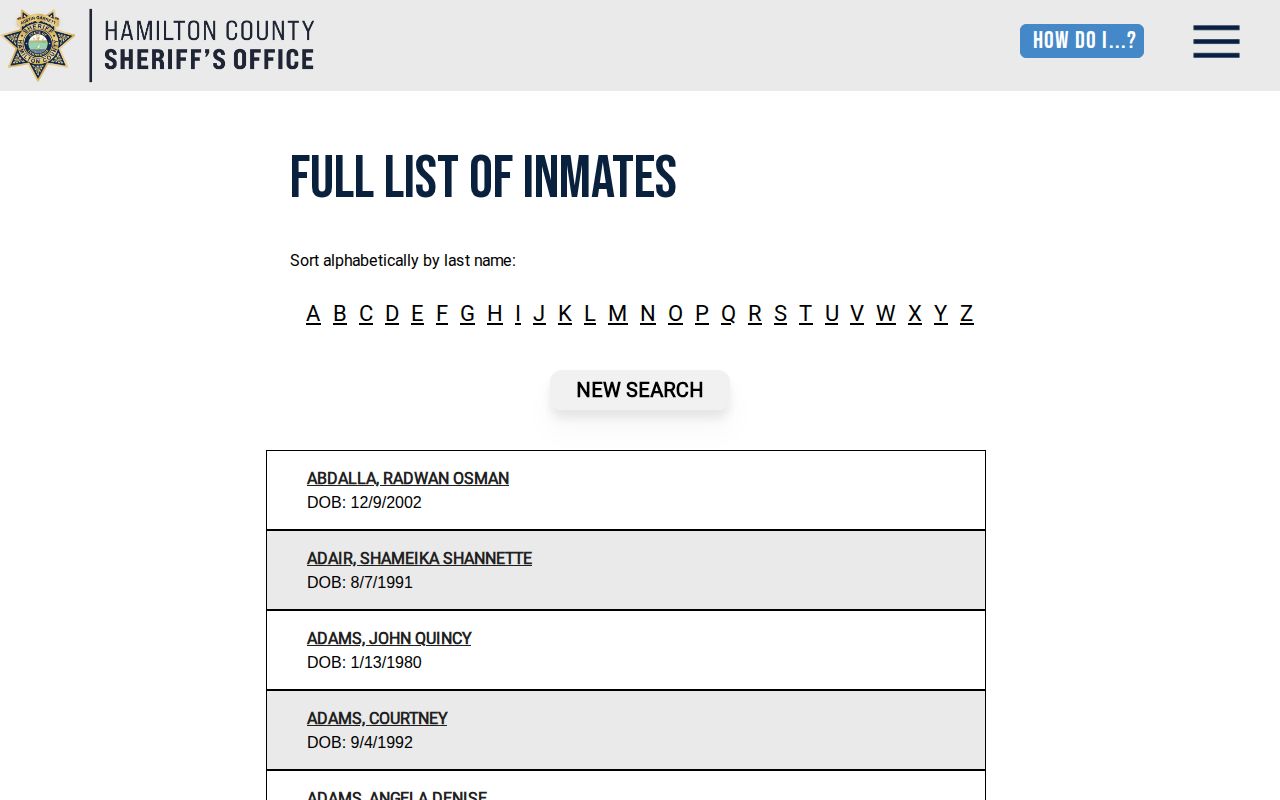
This live list can show continued HCSO custody, but it cannot reconstruct who departed during a past three-day period.
Hamilton Weekend Release Verification
A 72-hour question often arises on Monday or after an office closure. The wider span reduces the chance that a family member searches only the wrong calendar day. Still, the research found no HCSO public weekend or holiday release procedure, processing timetable, exit location, waiting area, or guaranteed posting cycle. Do not promise that a release will appear the next day or assume it happened when a bond order posted.
Separate legal authorization from physical departure. A court may enter a bond order or time-served judgment, then jail staff must complete the operational release. Another warrant, case, detainer, identity issue, or transfer can affect movement. CJUS typically has its own transaction-based delays, and those court update intervals do not describe the jail roster.
For each person, place the court event beside the HCSO or VINE custody event. If the times differ, report both. The court record explains the legal case; HCSO supplies gate time and destination. Call before traveling because no verified public family waiting or transportation procedure was found.
Hamilton CJUS guidance can add useful context across the longer span, but it runs on court-processing timelines rather than jail-release timing. Its FAQ describes typical delays for appearances, filings, and financial transactions, while the county disclaimer says the portal is nonofficial and cannot positively verify identity. A Monday court update may concern an earlier event. Use the Criminal Court Clerk for certified wording when the online chronology is unclear, then return to HCSO for the actual custody departure.
Obtain Hamilton Three-Day Release Proof
Direct confirmation and a focused records request replace the missing online feed. Call HCSO at 423-209-7000 or the jail at 423-209-7125 to identify the current records coordinator and submission method. No verified HCSO online request form, set release-record fee, or guaranteed response time was located. Ask about cost and delivery before the office begins work.
Identify one person and one booking. Request the booking date and time, actual release date and time, release type or legal authority, destination or receiving agency, associated charges, and bond disposition. If a record was withheld or no longer exists, ask for the legal basis and applicable retention schedule. Protected, sealed, juvenile, medical, victim, or security information may be withheld or redacted.
VINELink is the prospective alert path. Registration attaches to a matched person and can report a change from HCSO or TDOC. FOIL applies when the person entered state felony custody or supervision. It does not cover every Hamilton County booking. Hamilton CJUS can corroborate the disposition, but it does not supply the physical exit time.
Hamilton Booking Calendar Is Different
The date picker’s design makes it easy to mistake admissions for all jail activity. A person booked on the first day and held through the whole period will appear in the booking set. A person booked a week earlier and released during the 72-hour span will not. The tool therefore produces the wrong population for a recent-release question.
No release date, release time, type, destination, disposition, bond result, or photo appears in the rendered report. The absence of those fields is decisive. A wider date range cannot supply facts the source never records. Treat the calendar as admission context and seek the HCSO release record for the actual event.
Note: Historical booking dates are not proof of release-record retention, and HCSO has not published an online release archive period.
Where Hamilton Releases May Lead
A confirmed HCSO departure can lead to more than one place. Bond, recognizance, dismissal, time served, sentence completion, probation, or another court-authorized action may return the person to the community. A transfer may lead to TDOC, another county, BOP or USMS custody, ICE, a hospital, or another agency.
- Community release
- The person leaves confinement under bond, sentence completion, probation, or another valid authority.
- Transfer
- One custodian hands the person to another. It is a release from HCSO, but not a community release.
- Detainer
- A request or legal hold by another authority that may control the next destination.
- Discharge
- An official end to a sentence or supervision term, which is distinct from leaving one jail.
If TDOC FOIL shows “Incarcerated,” report the person as having moved into state custody. If it shows parole or probation, verify the date and supervision details. A missing local roster record never answers those state questions by itself.