
Hamilton County Parole and Probation
Parole and probation place a person in the community under rules, but they begin in different ways. The Tennessee Board of Parole decides whether an eligible state offender receives parole. The Tennessee Department of Correction then supervises parolees. TDOC also supervises people placed on felony probation or determinate release. A court, rather than the Board, imposes probation. Neither status erases the conviction or means the sentence has ended.
TCA § 40-35-501 supplies the state release-eligibility framework and includes determinate release provisions for some shorter felony sentences. Determinate release probation is a statutory supervision route. It should not be confused with a discretionary parole grant from the Board.
Bond belongs in a separate category. Someone who bonds out of the Hamilton County Jail & Detention Center is on pretrial release and may still face an unresolved charge. That person is not automatically on parole or probation. Likewise, “inactive” in TDOC's Felony Offender Information Lookup, known as FOIL, should not be casually translated into discharged. The sentence and release fields must be read together.
| Question | Parole | Probation |
|---|---|---|
| Who authorizes it? | The Tennessee Board of Parole for an eligible state sentence | The sentencing court under the applicable judgment and law |
| When does it begin? | After release from incarceration and completion of release processing | As ordered by the court, sometimes instead of or following confinement |
| Who supervises it locally? | TDOC community supervision | TDOC community supervision for covered state cases |
| What public clue appears? | FOIL may display parole status and location information | FOIL may display probation status and location information |
| How does it end? | By sentence expiration, discharge, or another controlling action | By completion or discharge under the judgment and supervising authority |
- Parole
- Conditional community release before the underlying sentence expires.
- Probation
- Court-ordered community supervision that may replace or follow custody.
- Discharge
- Formal completion or termination of the supervision obligation.
- Absconder
- A person alleged to have stopped complying with required supervision or contact.
Note: A Hamilton County bond release is a pretrial status, not parole or probation, even after the person leaves the jail roster.
Verify Hamilton County Post-Release Supervision
The official public starting point is TDOC Felony Offender Information Lookup. FOIL covers current and former felony offenders in TDOC custody or supervision. It can display a photograph, TDOC number, status, location, offense and sentence information, parole-hearing material, and release information. It does not cover every person who left the Hamilton County jail. A county-only misdemeanor, dismissal, or pretrial bond release may never create a TDOC entry.
Use several identifiers. Similar names can produce a false match, and Hamilton County's criminal court disclaimer warns that online data alone cannot positively establish identity. FOIL's status is the public lead; the assigned TDOC office or formal record is the stronger confirmation.
- Gather the full name, date of birth or approximate age, and TDOC or TOMIS number if known. Keep the Hamilton County case number or HCSO SPN available for comparison.
- Search FOIL by name, then narrow the match with the ID, photo, birth information, offense, county, and sentence details.
- Read the exact status. “Parole” and “probation” affirm community supervision. “Incarcerated” means the person remains in state custody. “Inactive” requires review of the sentence and release information.
- Check any location or supervision assignment shown. Do not assume every Hamilton County case is assigned to the Chattanooga office.
- Call the assigned TDOC field office when current confirmation is needed. For proof that supervision ended, request the discharge or supervision-termination record by TDOC number.
VINELink serves a different purpose. Tennessee VINE provides event notifications for participating county jails and TDOC, but it is not a permanent supervision registry. A custody release or transfer alert may explain when a person left an agency. It does not establish the terms or end date of parole or probation.
Hamilton County also has two separate VINE layers. Statewide custody VINE follows jail or TDOC custody events and offers live support at 888-868-4631. Hamilton VINE Courts, reached through the county courts page or at 1-866-277-7477, covers case events instead. A court-date, bond, or disposition notice can explain why custody may change, but it does not prove that the jail processed a release. Neither service replaces FOIL when the question is whether state parole or probation remains active.
The Tennessee Sex Offender Registry is another narrow public source, but only for people with a legal duty to register. A registry entry is not a general parole or probation record. Absence from that registry says nothing about supervision for a person whose offense does not carry a registration duty.
Hamilton County District 30 Supervision
TDOC's field-office directory assigns Hamilton County to District 30 in Chattanooga. An address on a FOIL record or a prior Hamilton County case does not by itself prove that this office currently holds the file. Caseloads and assignments can change. Confirm the assignment and office hours before traveling.
Chattanooga Probation and Parole, TDOC District 30
3602 Elwood Lane
Chattanooga, TN 37416
Phone: 423-634-6333
Fax: 423-634-6364
Hours: Confirm before appearing.
Have the TDOC number ready when calling. State the narrow question, such as whether District 30 is the assigned supervision office or how to request a discharge record. Staff may limit information that is private or protected. A public FOIL result and direct agency confirmation should be reported separately, with the date each was checked.
Hamilton County Parole Hearing Records
A parole eligibility date, hearing date, recommendation, final Board vote, and actual release are distinct events. The Board's Parole Hearings Division says hearing officers gather facts and make nonbinding recommendations. Board members may adopt, change, or reject those recommendations. A scheduled hearing therefore does not mean parole was granted.
The official Board site maintains separate state-prison and county-jail hearing schedules. It says schedules are updated each Monday, or Tuesday after a Monday holiday, and remain subject to change. Common entries include initial parole, review, revocation, and rescission matters. Report the Board's exact final wording, not a conclusion drawn from a calendar entry.
The Tennessee Board of Parole hearing page shows how the decision process is organized.
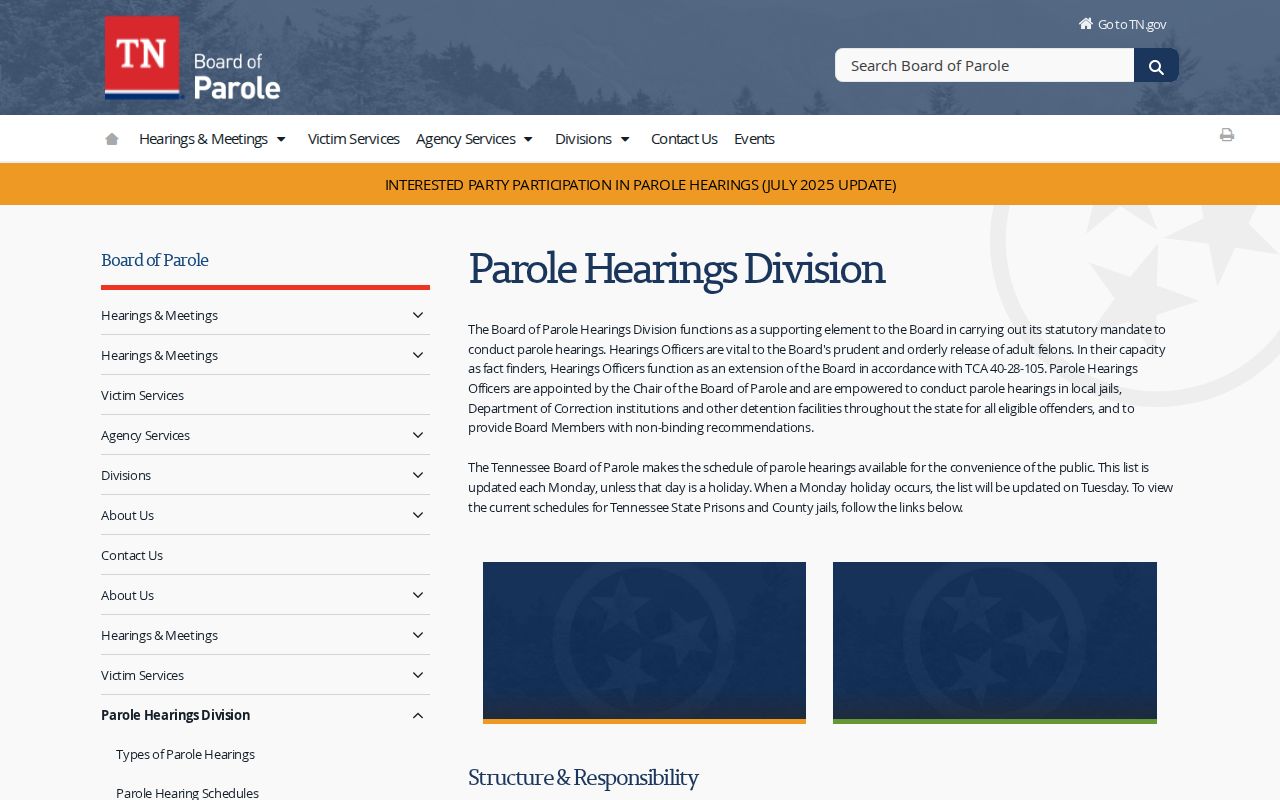
The image documents the official hearing resource, while FOIL and the final Board record remain necessary for a person's current result.
The public hearing material explains that three concurring Board votes form a final decision in some cases, four are required for most violent offenses, and two can revoke parole. The applicable voting rule depends on the conviction and law. Even a grant is not proof that a person walked out of prison that day. Release may wait for certificate processing, an approved plan, or resolution of a detainer. FOIL status and TDOC's release authorization show whether movement actually occurred. The Board central office can be reached at 615-741-1150 when the published schedule or result needs clarification.
Hamilton County Supervision Violations
Community supervision includes conditions set by the court, Board, and supervising authority. Those conditions are case-specific. They may regulate reporting, travel, conduct, programs, or other matters stated in the order or certificate. A public summary should not replace the controlling document or instructions from the assigned officer.
An absconder is not merely someone whose address is unknown to a friend or researcher. It means the person is alleged to have stopped meeting supervision or contact requirements. An outstanding warrant or violation allegation can lead to arrest even while FOIL continues to show a community status. A warrant is also not a final revocation. The court or Board must take the applicable action, and the chronology matters.
For a Hamilton case, compare FOIL with the Hamilton criminal case portal and verify court wording through the clerk when needed. HCSO warrant information may provide another lead, but a name match must be checked carefully. VINE can alert to a later custody event. None of those sources, standing alone, proves a final parole or probation decision.
Note: A warrant or absconder flag is an allegation or process step, not a final revocation of Hamilton County supervision.
When Hamilton County Supervision Ends
Release from a jail or prison and discharge from supervision are separate milestones. A person can live in Hamilton County on parole or probation for months or years after confinement ends. The obligation concludes only through the controlling sentence, judgment, discharge, or other official action. FOIL's “inactive” status is useful, but it should be paired with the sentence fields and, when proof is needed, a TDOC record.
Ask TDOC for a discharge or supervision-termination confirmation using the person's TDOC number. Court probation records can corroborate completion of a court-ordered term. A Board final action controls parole decisions, while the release authorization records the actual movement from prison. Tennessee's public-record framework allows access to many agency records, but the current Tennessee Code and agency rules may protect personal, sealed, or other confidential material.
The broader Hamilton County released-inmate search explains how the county release event, court outcome, and receiving agency fit together. Keeping those events separate prevents a roster disappearance from being mistaken for supervision discharge.
Hamilton County Reentry Before Release
HCSO's near-release reentry program is a distinctive local resource, but it is not a supervision lookup. The program serves sentenced men and women approaching release and uses an LS/CMI assessment, a structured tool for identifying risks and service needs. Its offerings include transition planning, recovery, parenting, literacy, and instruction linked with the Tennessee College of Applied Technology.
The program began in 2018 and has served more than 1,000 participants according to the cited Hamilton material. Some program hours may carry into continued education through Chattanooga State after release. Participation suggests that release planning is underway. It does not establish that the person has left the jail, has been placed on parole or probation, or has completed supervision.
Confirm the actual release with HCSO or VINE. Then use FOIL and the assigned TDOC office if state supervision is possible. This sequence respects the useful role of reentry services without turning program enrollment into a custody-status claim.
Note: Reentry participation can show planning near release, but it does not confirm release or later TDOC supervision.