
Hamilton Projected Versus Actual Release
A projected or scheduled date is a calculation based on information available at a particular time. Actual release is the event recorded when the person leaves that custodian. In Tennessee state records, the key forward-looking FOIL field is Release Eligibility Date, often shortened to RED. It is the earliest point at which an eligible person may be considered for parole or another statutory release process. RED is not a “projected release date,” a Board grant, a sentence-expiration date, or proof that the person will leave custody on that day.
Pretrial custody works differently. Someone held at the Hamilton County Jail & Detention Center before judgment has no sentence from which to calculate a prison release date. Bond, a dismissal, a plea, a court order, or a detainer may change the custody path. A person sentenced locally needs the court order and HCSO sentence record. A person committed to TDOC needs the state sentence calculation. Moving from HCSO to TDOC is a transfer, not community release.
Scheduled versus actual: RED opens an eligibility point. A Board action can authorize parole. TDOC release paperwork records movement. Only the custodian's actual release event confirms departure.
Note: A pretrial Hamilton County detainee has no sentence-based release date until a court enters a controlling order.
Find a Hamilton County Release Date
Begin by deciding whether the person is held in the county jail, serving a state sentence, or supervised in the community. The public systems overlap only in limited ways. HCSO's inmate search is a current-custody tool. Hamilton's court portal explains judgments and orders. TDOC's FOIL follows current and former felony offenders within the state system. None should be treated as a universal release calendar.
- Collect the full name, age or date of birth, HCSO SPN, TDOC or TOMIS number, case number, and sentencing county when available. Use more than a name to avoid a false match.
- Check HCSO Inmate Information when county custody is possible. A current result shows displayed custody, not a future release date. An absent result does not reveal when or why the person left.
- Read the judgment and later court action through the Hamilton criminal case portal. Verify important wording with the clerk because the portal is nonofficial and can lag.
- For a state felony sentence, search TDOC FOIL. Match the photo, TDOC number, birth details, offense, county, and sentence before reading RED or release information.
- Ask the correct custodian for direct confirmation. HCSO and the clerk handle a county sentence; TDOC handles its sentence computation, release authorization, and archived offender record.
The full Hamilton County released-inmate search covers the separate task of proving that a departure occurred. A date calculation should never be substituted for that release record.
Hamilton County FOIL Release Eligibility
FOIL covers felony offenders currently or formerly in TDOC custody or supervision. It may show a photo, status, location, offense, sentence information, parole-hearing information, and release details. Former-offender coverage makes it useful after a person has disappeared from the live county roster. It does not include every Hamilton County booking, particularly a county-only misdemeanor, a dismissal, or a pretrial bond release.
Open the matching detail and transcribe the label exactly. If the page says “Release Eligibility Date,” report RED with that meaning. Do not rename it “scheduled release,” “tentative release,” or “gets out on.” Status also matters. “Incarcerated” denotes state custody. “Parole” or “probation” denotes community supervision. “Inactive” calls for a closer reading of release and sentence fields and, if needed, an archived-record request.
The official TDOC FOIL page introduces the state lookup used for Hamilton County felony sentences.
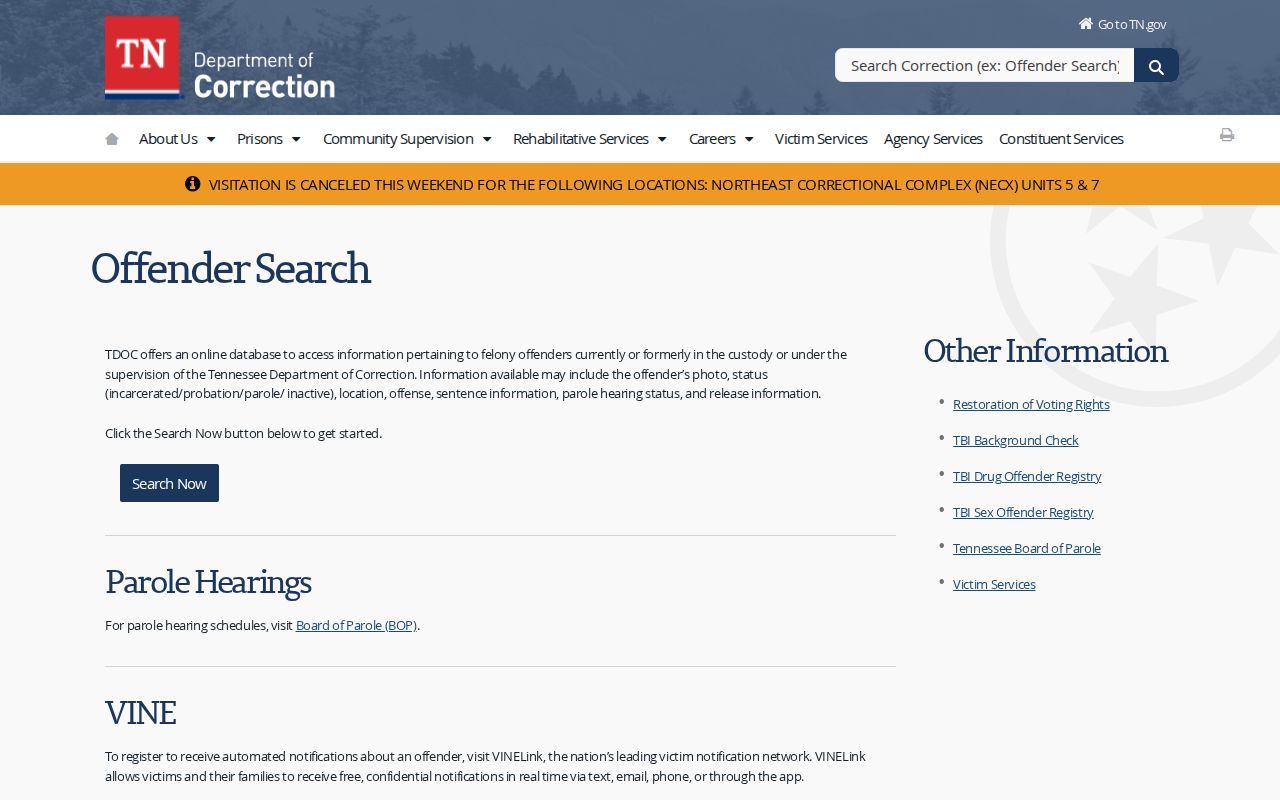
The captured page establishes the official search route, but a matched detail record and TDOC confirmation are required before attributing a date to a person.
FOIL calculations can change as TDOC receives judgments, jail-credit material, consecutive cases, or corrected documents. Save the TDOC number and the date checked. For older or fuller documentation, the TDOC Archived Record Request identifies the route and asks for a full name, TOMIS number, birth date, and other matching information.
Hamilton County Release Eligibility Percentages
Tennessee does not apply one universal percentage to every sentence. TCA § 40-35-501 assigns release-eligibility rules based on the offender range, offense, offense date, judgment, and other statutory details. Consecutive sentences must be calculated separately and then combined as the statute directs. A percentage taken from one count can therefore produce a materially wrong estimate.
| Sentence category | General eligibility point documented in research | Required caution |
|---|---|---|
| Especially mitigated | 20% or 30%, as stated in the judgment | The judgment and applicable subsection control |
| Range I standard | 30% | Credits and special offense rules still require review |
| Range II multiple | 35% | This is eligibility, not automatic release |
| Range III persistent | 45% | Consecutive cases can extend the calculation |
| Career offender | 60% | The exact conviction and offense date remain essential |
Only felony sentences longer than two years generally proceed to parole consideration under the current statutory structure described in the research. Shorter eligible terms may use determinate release rules. The judgment and the version of the statute tied to the offense date remain controlling.
The common statement that Tennessee requires everyone to serve 85% is wrong. Listed firearm offenses committed during specified periods can fall under an 85% framework with detailed credit limits. Other enumerated serious offenses may require 100% service, sometimes with restricted program-credit treatment that can affect parole eligibility by no more than 15% without reducing sentence expiration. Multiple violent offenses committed on or after July 1, 2022 receive separate 100% or sharply restricted treatment.
Offense date is critical because the General Assembly has amended these provisions. For offenses committed on or after July 1, 2024, subsection (ff) changes how credits affect parole eligibility compared with sentence expiration. Only the version of the law applicable to the conviction and date can support a calculation.
Hamilton County Release Sentence Credits
TCA § 41-21-236 supplies Tennessee's prisoner sentence-reduction credit framework. Credits are governed by law and TDOC policy, not by a flat subtraction from the sentence. They can depend on conduct or program performance and may be earned, withheld, forfeited, or restored. Section 40-35-501(n) also permits a RED deferral for disciplinary violations through the required procedures.
Credits do not give a prisoner a warranty of release on RED. The Board still decides parole in eligible cases, and a release plan or detainer may affect movement after a favorable decision. Sentence expiration is another date entirely. It marks the calculated end of the imposed term, though a separate warrant, sentence, or receiving agency can continue custody.
Hamilton County jail calculations must come from the local sentencing order and sheriff's sentence record. No Hamilton-specific public good-time schedule or weekend-release rule was verified in the research. Applying TDOC prison arithmetic to a pretrial detainee or local misdemeanor would be unsupported. Ask HCSO and the clerk for the jail-credit calculation, controlling authority, and actual release record.
Note: No verified public Hamilton County good-time or weekend-release schedule supports a do-it-yourself county jail release calculation.
Why Hamilton Release Dates Change
A date can move because the legal record, sentence calculation, conduct record, or custody destination changes. The reason should be tied to an official document rather than guessed from a different date on FOIL.
| Factor | Possible effect | Best confirmation |
|---|---|---|
| Corrected or delayed judgment | Changes the sentence inputs TDOC received | Certified judgment and TDOC sentence record |
| Consecutive sentence | Adds separately calculated periods | Every judgment and the TDOC computation |
| Pretrial jail credit | Changes credit for time already held | Court order and custodian calculation |
| Earned, lost, or restored credits | Can move eligibility within statutory limits | TDOC sentence-credit record |
| Disciplinary action | May defer RED under applicable procedure | TDOC disciplinary and calculation record |
| Appeal or later court order | May change the conviction or sentence | Court docket and certified order |
| Board action | May grant, deny, defer, continue, revoke, or rescind parole | Final Board action, not the hearing date |
A detainer may not alter the sentence date displayed, yet it can change the destination. TDOC policy distinguishes release to another authority from arrival in the community. If HCSO, TDOC, federal authorities, or ICE receives the person, follow that agency's locator or record. “Released by TDOC” can describe a lawful handoff rather than physical freedom.
Note: A date change and a destination change are different issues, so check both the calculation and any receiving authority.
Hamilton Jail and TDOC Release Dates
The Hamilton County Jail & Detention Center is the correct custodian for its booking and county release event. Its public tools include a current-inmate search and a date-selected booking report. The booking report shows an admission event, not a projected or actual release. HCSO publishes no verified local good-time table, weekend-release schedule, or public projected-date calculator.
For a county-held person, begin with the judgment. General Sessions Criminal enters final misdemeanor and traffic judgments and handles felony cases before bind-over. Criminal Court handles cases after indictment, presentment, information, or appeal. The Hamilton Courts path and CJUS portal help locate the order, while the clerk provides official verification. A “time served” judgment may authorize release from that case, but another case or detainer can still prevent departure.
TDOC becomes the authority after commitment to a state sentence. FOIL shows the state record, and TDOC policy 511.03 identifies formal release-authorization fields such as release type and date, sentence expiration, releasing authority, detainer information, and intended residence city and state. County roster disappearance followed by an incarcerated FOIL result indicates transfer to state custody, not community release.
Hamilton Parole Decisions and Release
Reaching RED creates eligibility for consideration where the sentence allows it. The Tennessee Board of Parole may grant, deny, defer, or continue a matter, and later proceedings can revoke or rescind parole. A hearing officer's recommendation is nonbinding. The final Board action must be read by its exact terms.
A grant still does not prove same-day release. Certificate processing, release-plan approval, detainer resolution, or another condition can delay actual movement. FOIL's later supervision status and TDOC's release authorization supply the stronger evidence that the person left prison. Families of people in TDOC institutions may also seek information from the institutional probation and parole officer identified by the Board.
The Board schedule hub separates state-prison and county-jail calendars and says schedules update weekly, subject to change. A past calendar date should never be reported as a grant or release date.
Confirm a Hamilton County Release Date
Record the system, exact label, value, and time checked. For a state sentence, compare FOIL with the judgment and ask TDOC about the sentence calculation or release authorization. For a local sentence, ask HCSO at 423-209-7125 and verify the controlling order with the Hamilton Criminal Court Clerk at 423-209-7500 or General Sessions Criminal at 423-209-7600.
VINELink adds event notice, not a guaranteed forecast. Register against the matched Tennessee custody record and preserve the reporting agency and timestamp when an alert arrives. The VINELink Check explains the Hamilton jail and TDOC notification layers. A “transferred” event requires a receiving-agency search, while a missing VINE result is not affirmative proof of release.
No single date answers every question. RED addresses eligibility. A final Board action addresses parole authority. Sentence expiration addresses the calculated term. The release authorization and custodian event address actual movement. Reporting each one by its own name produces a defensible Hamilton County release timeline.