
Federal Prison Release Scope
The Federal Bureau of Prisons confines sentenced federal prisoners in institutions across the United States. No federal prison was verified inside Hamilton County. A person arrested or prosecuted in the Chattanooga area may be housed far from Tennessee after sentencing, so the institution name in a federal result should not be converted into a Hamilton County facility. The BOP locator follows the national system, regardless of where the federal case began.
Federal pretrial custody is different. The United States Marshals Service usually manages federal defendants before sentence and designation, often through contracted detention arrangements. Research found no public USMS historical release locator comparable to the BOP tool. A federal docket, detention or release order, receiving custodian, counsel, or a narrow USMS records request may be needed for that stage. BOP becomes the main public locator after a person enters its sentenced-prison system.
BOP Federal Release Locator
The BOP Inmate Locator covers federal records from 1982 to the present. The most precise search uses a BOP register number, DCDC number, FBI number, or INS number. A name search is also available, with optional age, race, and sex fields to narrow results. Names alone can create a false match, so compare every displayed identifier and demographic detail before accepting the record.
Results can include the person’s name, register number, age, race, sex, release date, and location or status. BOP explains that “Released” or “Not in BOP Custody,” with no institution, means the person is no longer held by BOP. Preserve the exact phrase. “Not in BOP Custody” is narrower than “not in custody.” It does not exclude state, county, immigration, or another federal agency’s authority.
| Search key or field | Use |
|---|---|
| BOP register number | Best public identifier for the BOP record |
| DCDC, FBI, or INS number | Alternate identifier route |
| Name with age, race, sex | Biographical search when no number is known |
| Release Date | Date displayed by BOP, subject to correction |
| Location or status | Institution or out-of-BOP wording |
The project capture below comes from the official BOP Inmate Locator.
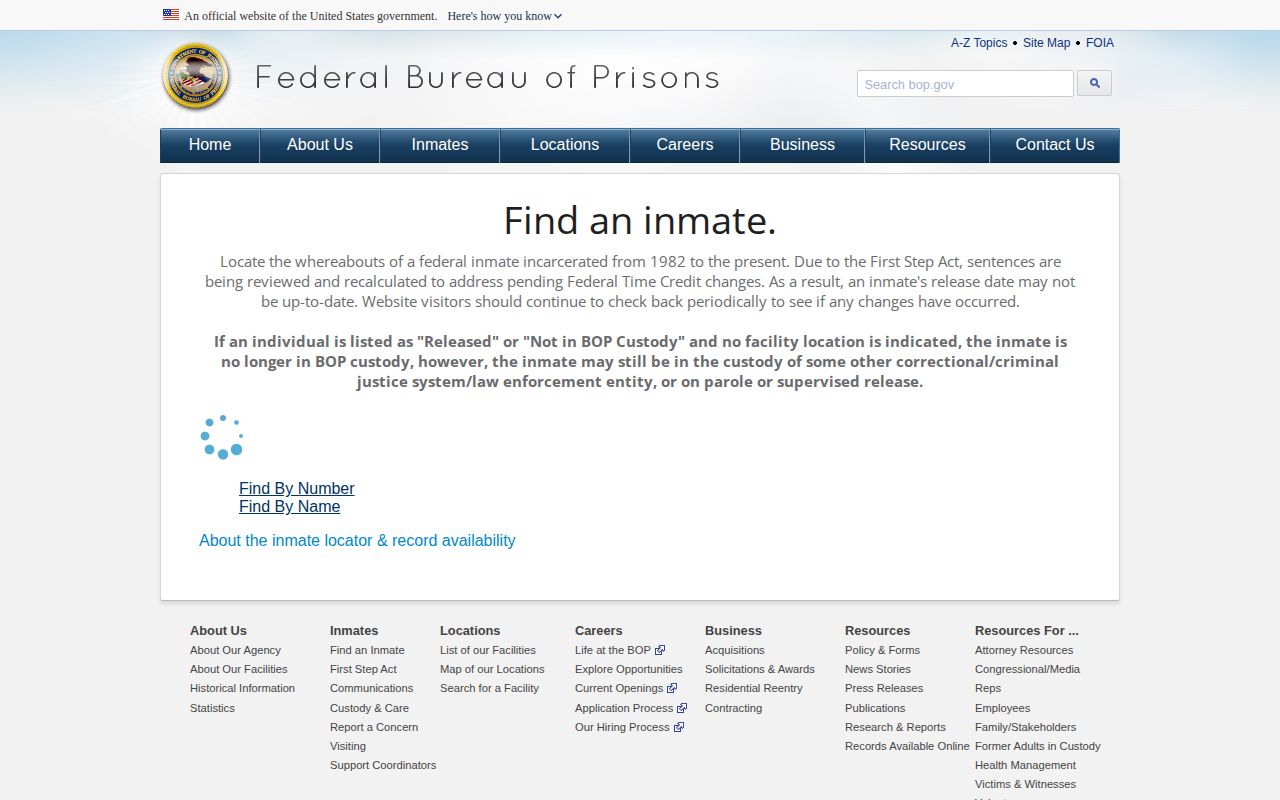
The locator supports a federal custody check, while the surrounding steps make clear that it does not search HCSO, TDOC, USMS, or ICE records.
Confirm Federal Prison Releases
Start with the strongest identifier and record the search date. If BOP shows a release date, save the register number, name, status phrase, and institution field exactly as displayed. Release dates may change as calculations and credits are updated. A current result is evidence of what BOP displayed at that time, not a permanent guarantee that every underlying record is complete.
Next read the federal court docket. A sentencing judgment, release order, remand, supervised-release condition, violation filing, or transfer order can explain the legal timeline. Supervised release is a period overseen through the federal court and probation system after imprisonment. It is not Tennessee parole. A person may be outside BOP prison yet still have binding federal conditions.
- Search by BOP, DCDC, FBI, or INS number when one is known.
- For a name search, add available matching traits and compare the full result.
- Record the register number, displayed Release Date, location or status, and lookup time.
- Read the federal docket for orders and supervised-release terms.
- Check state, local, or ICE sources when the case or BOP record suggests another custodian.
- Use BOP FOIA for a properly scoped record that the public locator does not provide.
Note: “Not in BOP Custody” confirms only that BOP is not the displayed custodian at the time checked.
Federal Release Destinations
A person may leave a BOP institution for the community, but a destination can also involve another authority. BOP’s aggregate release statistics exclude some transfers to another jurisdiction, a state sentence, or ICE. Those totals cannot verify an individual, yet they show why “release” inside one federal dataset is not always a return home. The individual result, docket, and receiving-agency record carry more weight.
If immigration custody is plausible, search the ICE Online Detainee Locator promptly. ICE reports that its tool includes people released from ICE custody only for a short post-release period. If a state sentence follows, use that state’s correctional locator. For a Tennessee state case, TDOC FOIL may show incarceration or supervision. If Hamilton County custody follows, contact HCSO and use its current jail search.
| After BOP | Verification route | Caution |
|---|---|---|
| Community with federal supervision | Federal docket and probation records | Outside prison does not mean sentence obligations ended |
| State or county custody | State DOC or local jail record | BOP status cannot report another agency’s custody |
| ICE custody | ICE detainee locator and agency contact | A federal handoff is a transfer |
| Unknown destination | BOP record, docket, and scoped records request | Do not infer community release |
Federal Prison Release Records
The public locator is the first path, but it is not a full institutional file. BOP’s Freedom of Information Act page provides the request route for records beyond the public result. Privacy limits, identity verification, exemptions, and authorization rules may restrict what can be disclosed. Ask for the narrow event needed, such as release documentation or sentence computation, rather than an entire file.
A useful request states the full name, register number, date of birth as appropriate, institution, approximate release period, and precise record sought. Ask for electronic delivery where available and request advance notice of cost. If BOP withholds part of the record, seek the cited exemption and a segregable copy of any releasable fields. A federal court docket can often supply the legal order even when operational prison details remain limited.
Keep the BOP record distinct from an HCSO booking, TDOC sentence, or ICE result. A shared name is not enough to merge them. Compare identifying numbers, birth details, offenses, court district, and chronology. If dates conflict, report what each agency displayed and request clarification from the source that created the disputed field.
Hamilton Federal Release Connections
A Hamilton County arrest does not become a federal case merely because a federal agency is involved later, and a federal case does not place the person in the Hamilton County jail system by default. Begin with the charging court and custodian. HCSO confirms its own jail event. The federal docket explains federal detention and sentencing orders. USMS handles much of the federal pretrial stage. BOP handles sentenced federal imprisonment. ICE handles immigration custody.
For a person who first appears in HCSO records, request the county release or transfer destination. If HCSO names USMS or another federal authority, follow the federal docket and receiving custodian. Do not call that county departure a BOP release. The person may not yet have entered BOP, and a pretrial detainee may have no BOP release date.
The Hamilton County release lookup explains how the local booking and court record fit before a federal handoff. Limit the timeline to sourced events: county booking, county departure, federal detention order, BOP admission, federal release date, and any supervised-release term. Each may arise from a different record.
BOP Release Contact Route
BOP is presented here as a national system rather than a local contact card. The locator and FOIA page are the official public routes documented by the research. For a named institution, use BOP’s official institution information after confirming the locator result. No Hamilton County street address or phone should be invented for a system with no verified local prison.
Federal Bureau of PrisonsNational federal prison system
Public route: BOP Inmate Locator
Records route: BOP FOIA
No BOP institution was verified in Hamilton County.
USMS record questions follow the Marshals Service FOIA route, subject to its rules. Court-order questions belong with the federal clerk or counsel. A phone or written response should be logged with the date, office, staff unit, question, and exact answer. Attribute every status to its source rather than combining several agencies into one broad conclusion.
When the locator shows a historical release, preserve a dated copy if lawful and necessary. The result may later change after a correction. A dated note allows the federal record to be compared with later court or custody events without claiming that the person stayed free of all custody.
BOP Release Court Records
Retain the federal court district and case number when known. Those keys help separate people with similar names and connect the BOP event to the correct judgment, supervision filing, or transfer order. A docket may show why the legal release date and the operational departure from an institution differ. It can also show a later remand or alleged violation without changing what BOP previously reported.
Read the docket in date order and preserve the title of each order. A sentencing judgment, release order, or supervised-release filing answers a different question from the locator. Pairing them produces a sourced chronology without asking either system to report facts that belong to the other.